
By: Asif Nabi Dar, President — Jammu Kashmir National Democratic Party (JKNDP)
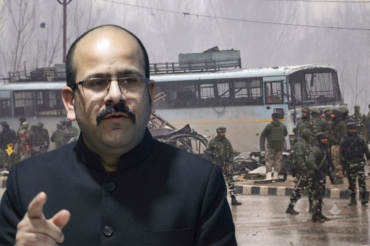
The martyrdom of 40 of our brave CRPF personnel in Pulwama on February 14, 2019, was not a routine act of terrorism; rather, it stands as one of the most severe security, administrative, and political failures in the history of independent India. As the President of the Jammu Kashmir National Democratic Party (JKNDP), I, along with my party, condemn (Mazammat) in the strongest possible terms the systemic political errors and administrative negligence that ultimately cost our brave soldiers their lives.
Facts that have surfaced over time, coupled with observations from defense experts and explicit statements from individuals who held top constitutional posts, have made it glaringly obvious that the blame cannot be shifted entirely to cross-border terrorism. The policymakers sitting in the corridors of New Delhi share equal responsibility due to their profound complacency and criminal negligence. As a responsible political organization, we firmly believe that nationalism should not merely be used as a tool for election slogans, but must manifest as a concrete commitment to the safety of our soldiers and clear accountability within the governance framework. Through this piece, I wish to place before the public the fundamental political blunders that have been systematically drowned out by loud nationalistic rhetoric.
1. The Outright Rejection of the Request for Air-lift
At the time of the attack, the Jammu-Srinagar National Highway had been shut down for several days due to heavy snowfall and inclement weather. More than 2,500 personnel were stranded in Jammu, even as their deployment in the Valley was urgently required. Top officials of the CRPF had repeatedly made written requests to the Central Government and the Ministry of Home Affairs to transport these troops via aircraft to Srinagar.
Tragically, bureaucratic insensitivity and a lack of political foresight led to this highly justified and safety-critical demand being summarily rejected. Consequently, a massive and slow-moving convoy of 78 vehicles was ordered to move by road, rendering them a vulnerable target for anti-national elements. Had the government arranged for aircraft in a timely manner, the lives of these 40 fathers, sons, and husbands could have been saved.
2. Gross Disregard for Precise Intelligence Alerts
Prior to the attack, intelligence agencies had issued specific, actionable inputs. The intelligence reports explicitly warned that Jaish-e-Mohammed (JeM) was planning to target security convoys using IEDs or vehicle-borne improvised explosive devices (VBIEDs/car bombs).
During this period, Jammu and Kashmir was not run by an elected democratic government; it was under the direct administration of the Central Government via the Governor’s rule. Under such a mechanism, the breakdown of basic coordination among local intelligence, state police, and central security forces is deeply alarming and highly condemnable. Such laxity at the highest echelons of national security can only be categorized as a severe administrative and political failure.
3. Breach in the Counter-Insurgency Grid and the Unchecked Movement of RDX
The Kashmir Valley is globally recognized as one of the most heavily militarized zones with a robust, multi-tiered counter-insurgency security grid. It baffles logic how a vehicle laden with nearly 300 to 350 kilograms of lethal explosives (RDX) could move completely undetected through these roads.
This points directly to a massive breakdown in checkpoint monitoring and basic frisking along the slip roads connecting to the national highway. How did such an enormous cache of explosives breach multiple security layers to reach the main highway? The nation still awaits an answer to this question. This level of operational failure on the ground is a direct reflection of a lack of political will and lax oversight.
4. Suppression of Failures and the Blatant Politicization of a Tragedy
Perhaps the most deeply distressing aspect of this tragedy was the political theater that followed. Former Governor Satya Pal Malik publicly admitted that when he raised the issue of these critical security lapses and the failure of the Ministry of Home Affairs directly with the Prime Minister, he was explicitly instructed to remain completely ‘silent’ on the matter.
In a thriving democracy, a national security crisis of this magnitude should have resulted in immediate accountability and action against top political and bureaucratic officials. Instead of introspecting on these systemic vulnerabilities, the ruling administration chose to weaponize the subsequent military retaliation (the Balakot airstrike) as a political tool and a core electoral narrative during the 2019 general elections. This remains the pinnacle of capitalizing on the ultimate sacrifices of our soldiers for electoral gains.
The Jammu Kashmir National Democratic Party (JKNDP) does not believe in criticism for the sake of opposition; we demand structural reform and absolute justice. We demand that all administrative and political files pertaining to the inquiry of the Pulwama attack be made public, so that the citizens of this country can learn where the real accountability lies.
We strongly oppose a system where the martyrdom of soldiers is used to gather votes, while the basic resources required for their safety are compromised due to bureaucratic red tape. Our party stands firmly with the people of Jammu and Kashmir and every family across the nation that lost its light due to the failures of this establishment. We unequivocally condemn (Mazammat) this entire episode and the political negligence behind it, and we will continue to raise our voice until accountability is firmly established.
Jai Hind. Jai Jammu-Kashmir.
Asif Nabi Dar
Party President, Jammu Kashmir National Democratic Party (JKNDP)