
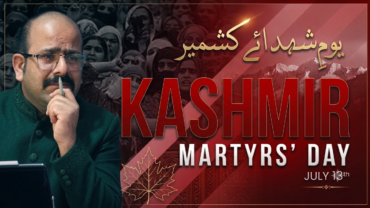
By Asif Nabi Dar President, Jammu and Kashmir National Democratic Party
SRINAGAR 13 July 2026
History is never just a collection of dates written on paper; it is the living mirror of struggles and sacrifices that shape the collective consciousness of a society. July 13 stands as one of the most significant turning points in the modern history of Jammu and Kashmir. Today, as we reflect on this historic day, as the President of the Jammu and Kashmir National Democratic Party (JKNDP), I choose to present this day not through a narrow political prism, but through the lens of absolute historical truth and the proud perspective of an Indian citizen (As an Indian).
The time has come to rescue this day from hollow political theaters and present the raw, unadulterated truth to the public.
The Real Historical Truth: What Actually Happened on That Day?
To understand the tragedy of July 13, 1931, one must look closely at the socio-economic and administrative structures of that era:
The Exploitative Backdrop: In 1931, Jammu and Kashmir was ruled by the Dogra monarch, Maharaja Hari Singh. The absolute majority of the population in the Kashmir Valley lived in extreme poverty. The average Kashmiri peasant, weaver, and laborer groaned under the crushing weight of exorbitant taxes and the institutionalized practice of begar (forced labor without wages). The complete denial of basic civil liberties, combined with specific incidents of religious interference in the months leading up to July, pushed public resentment to a boiling point.
The Speech of Abdul Qadeer: In June 1931, an outsider named Abdul Qadeer, who was traveling as a domestic employee with a vacationing British military officer, addressed a massive public gathering at the historic Khanqah-e-Moula shrine in Srinagar. He delivered an impromptu, highly charged speech against the injustices of the autocratic regime, urging the people to stand up for their rights. The state administration viewed this as treason and promptly arrested him.
The Fortified Trial: Fearing widespread public unrest, the government decided to hold Qadeer’s trial inside the high-walled, heavily guarded Srinagar Central Jail instead of an open court. On the morning of July 13, 1931, thousands of unarmed citizens converged outside the jail premises to show solidarity with their leader.
The Azaan and the Massacre: As the afternoon approached, the time arrived for the obligatory Zuhr (noon) prayers. A young man from the crowd stood up to deliver the Azaan (the Islamic call to prayer). Fearing a jailbreak or a riot, the administration panicked, and under the orders of the Governor, the police guards opened fire on the unarmed assembly. Historical accounts record that as the first man fell, another stepped forward to continue the call to prayer, only to be shot as well. The state forces fired indiscriminately for nearly 15 minutes, leaving 22 Kashmiri citizens dead and dozens severely wounded.
As a Proud Indian: Should We Commemorate This Day?
A critical question often raised in contemporary discourse is whether we, as citizens of democratic India, should observe this day. My categorical answer is—Yes, absolutely, but in its true historical context.
A Revolt Against Autocracy, Not a Communal Divide: We must recognize that the uprising of July 13, 1931, was not a rebellion against any specific community or nation. It was a righteous revolt by the common people against an oppressive feudal system and an autocratic monarchy.
An Integral Part of the Anti-Colonial and Anti-Feudal Struggle: Just as freedom fighters across the rest of British India—under the leadership of Mahatma Gandhi, Bhagat Singh, and Netaji Subhash Chandra Bose—were fighting against British imperialism and their proxy princely states, the people of Kashmir were fighting their own battle for democratic rights. As citizens of a sovereign, democratic India, it is our duty to respect every historical movement that laid the foundation for human dignity and public representation. The martyrs of 1931 ignited the flame of democratic consciousness in Kashmir, which ultimately paved the way for Kashmir’s historic integration with the democratic Republic of India.
The JKNDP Stance: The Annual Political and Graveyard Drama Must End
While we hold the ultimate sacrifice of these 22 souls in the highest regard, I must speak the bitter truth clearly to our people:
I firmly believe that staging this routine political drama every single year over this historic event is entirely unacceptable, counterproductive, and misleading to the public.
The Islamic and Religious Perspective: The annual ritual of opportunistic politicians visiting the graveyard, displaying transactional grief, and arranging decorative flowers and flowerpots has degraded into nothing more than cheap political optics. If we look at this through a purely Islamic perspective, Islam does not permit or encourage such acts of public exhibitionism, placing ritualistic offerings on graves, or converting final resting places into centers for political gain.
The Absence of the Victims’ Families: The most glaring and undeniable truth remains: to the best of my knowledge, the actual descendants and families of these martyrs have never come forward to participate in these annual political spectacles. When the biological families of the victims distance themselves from this political theater, by what right do these political factions claim ownership over their graves to revive their failing politics?
Politicians must stop using the mazar as a seasonal stage to confuse and mislead the common masses. Reducing the profound sacrifices of our ancestors to annual press releases, vote-bank calculus, and mutual mudslinging is a grave disservice to their memory.
Our Unshakable Pledge: Choose Progress and Development Over Hollow Slogans
The Jammu and Kashmir National Democratic Party (JKNDP) believes that a genuine tribute to the martyrs of July 13 cannot be achieved by posing for cameras at a graveyard. It can only be fulfilled by practically implementing their democratic principles in modern governance:
Corruption-Free and Just Administration: Just as the voices in 1931 rose against predatory administrative practices, our party stands unflinchingly for an accountable, transparent, and corruption-free government today.
Real Empowerment of Our Youth: Our ancestors laid down their lives for a future where subsequent generations could live with their heads held high. Today, our youth do not need the politics of graves and slogans—they need quality education, sustainable employment, and a secure future.
Commitment to the Nation: Drawing inspiration from global and national icons of justice like Mahatma Gandhi, Dr. B.R. Ambedkar, and Dr. A.P.J. Abdul Kalam, JKNDP remains fiercely committed to safeguarding the democratic rights of every citizen across Jammu, Kashmir, and Ladakh, while upholding the integrity of the nation.
We must rescue the public from political confusion and channel our energy into building a new era of Peace, Progress, and Prosperity in Jammu and Kashmir. That will be the truest tribute of a patriotic Indian to the martyrs of July 13.
Jai Hind.
Asif Nabi Dar, President – Jammu and Kashmir National Democratic Party